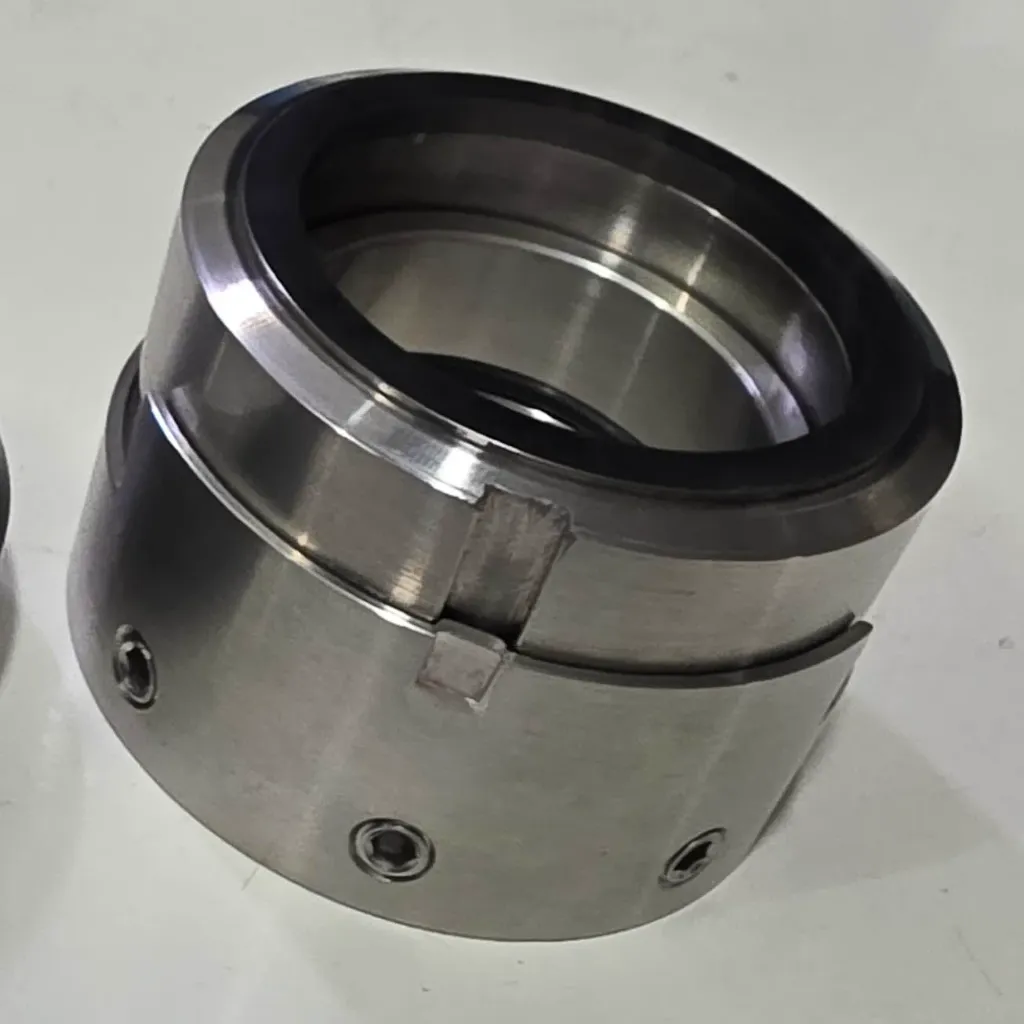
MS050080S | Mechanical Seal SET | 50 x 80 x 53 mm | Silicon Carbide
Full Mechanical Seal Set: 50mm Rotary (SiC) & 74mm Stationary (Carbon)
This listing covers the complete assembly required for a high-integrity shaft seal. By pairing a Silicon Carbide (SiC) rotating face with a Carbon stationary seat, this set provides an ideal balance of durability and self-lubricating properties, reducing friction while maintaining a high-pressure seal.
Product Overview
This modular seal set is designed for industrial pumps and agitators. The SiC/Carbon material pairing is a "gold standard" for general industrial use, as the carbon seat provides excellent dry-running safety margins, while the SiC rotary face handles abrasive particles and heat dissipation.
Component Specifications
1. Rotating Part (SiC)
Inner Diameter (Shaft): 50 mm
Outer Diameter: 80 mm
Length: 53 mm
Material: Silicon Carbide (Hard, high-wear resistance)
2. Stationary Part (MS074056C)
Outer Diameter: 74 mm
Inner Bore: 56 mm
Thickness/Depth: 23 mm
Material: Resin-Impregnated Carbon (Self-lubricating)
Technical Data Table
| Feature | Specification |
| Material Pairing | Silicon Carbide (Rotary) vs. Carbon (Stationary) |
| Compatible Shaft Size | 50 mm |
| Seal Type | Single Component Seal |
| Elastomers | High-Grade FKM (Viton) / EPDM |
| Max Pressure | Up to 12 Bar (depending on pump RPM) |
| Temperature Range | -20°C to +180°C |
Why Use the SiC vs. Carbon Combination?
Low Friction: The Carbon stationary part acts as a solid lubricant, allowing for smoother startups and reducing the torque required.
Heat Dissipation: Silicon Carbide quickly moves heat away from the seal faces, extending the life of the elastomers.
Cost-Effective Durability: Using a Carbon seat with a SiC head is more economical than Double-SiC sets while still offering superior life compared to Ceramic alternatives.
Installation Note
Ensure that both the rotary and stationary faces are cleaned with a lint-free cloth and a degreasing agent before assembly. Even a fingerprint on the seal faces can cause a microscopic leak path during high-pressure operation.